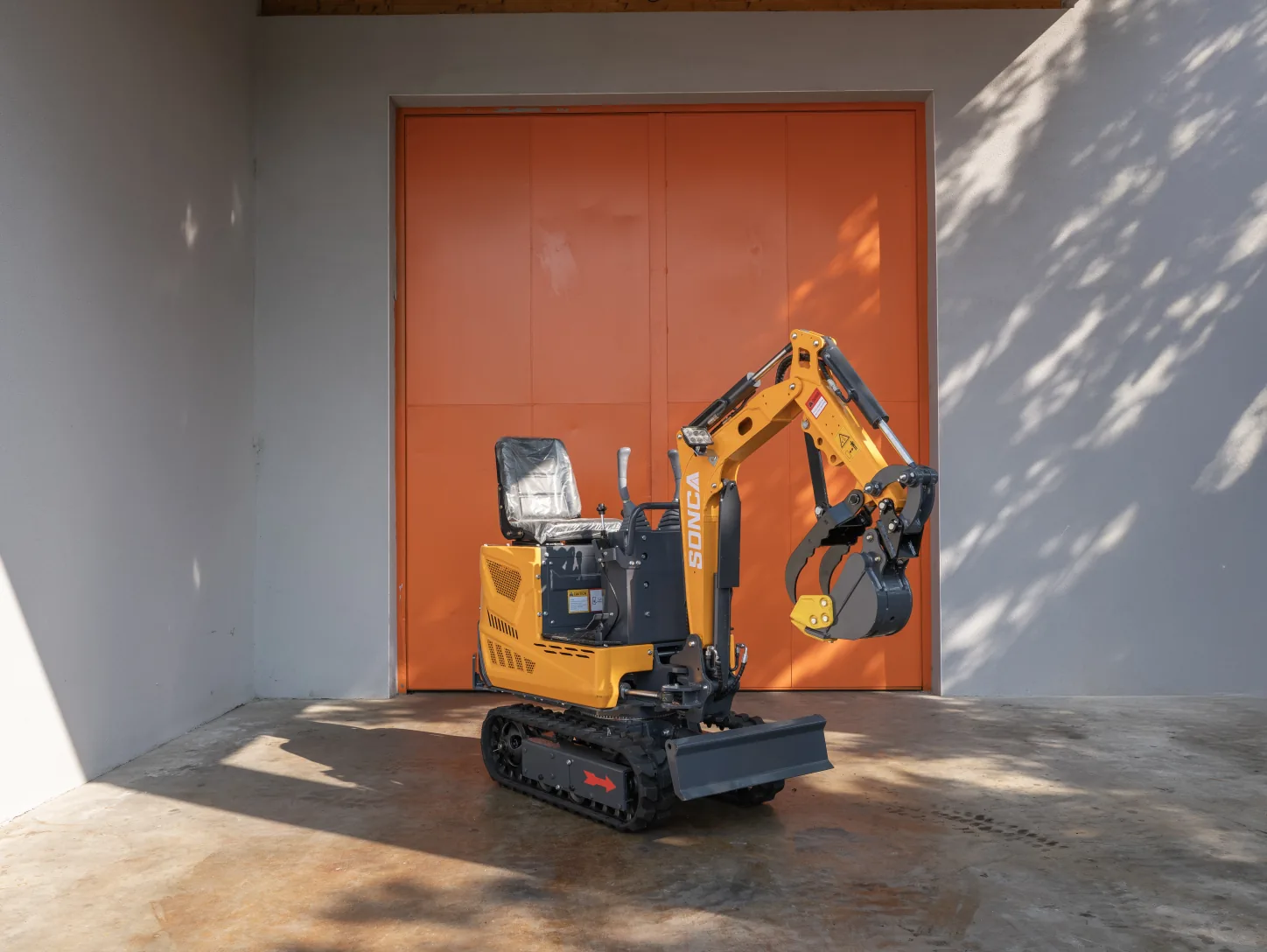
On a mini excavator, the rubber tracks provide traction, distribute the machine's weight over the ground and protect fragile surfaces (paving, lawn, tarmac) all at once. They are subjected to considerable stress: abrasion, torsion, impacts, and exposure to UV and hydrocarbons. Yet their maintenance is one of the most frequently neglected items among users, even though it directly determines the service life of the undercarriage and the safety of the machine.
This guide covers the essentials: tension, identifying wear, good prevention practices, replacement and the real service life of mini excavator tracks. It complements our general mini excavator maintenance guide, which is worth consulting for all periodic operations.
Why your tracks deserve your attention
Unlike tyres, rubber tracks continuously work under flexion around the sprocket (drive wheel), the idler wheel and the rollers. Every rotation stresses the internal metal reinforcement and the rubber carcass. A poorly adjusted or worn track sets off a cascade of problems:
- Loss of traction and slippage on loose ground or on slopes;
- Accelerated wear of the sprocket, rollers and idler wheel, whose replacement costs far more than a track;
- Risk of the track coming off (detracking) mid-manoeuvre;
- Vibrations and irregular movement that fatigue the entire chassis.
In other words, monitoring your tracks means protecting the whole undercarriage. On the compact models in our mini excavator range, this check takes just a few minutes and fits easily into the daily routine.
Checking and adjusting tension
Tension is the leading cause of premature wear. A track that is too tight exerts excessive pressure on the bearings, sprocket and internal reinforcement: it heats up, stretches and can even snap its metal cables. A track that is too loose risks derailing, jumping the sprocket teeth and wearing the pads unevenly.
How to check
- Place the machine on flat, stable ground with the engine off.
- Slightly raise one side using the blade and the arm (a task to be carried out with care, following the instructions in the manual).
- Measure the sag: this is the drop of the track between the rollers, on the upper run. The target value depends on the model but generally falls within a range of a few centimetres.
Always refer to the exact value specified by the manufacturer for your machine. If in doubt, our technical department can give you the correct figure for your model.
How to adjust
Most mini excavators use a hydraulic tensioning system operated via a grease nipple. To tighten, you inject grease into the tensioner cylinder using a pump. To slacken, you slightly loosen the fitting or valve to let a little grease escape — a task to be done carefully, as the grease is under pressure. Make the adjustment in small increments and recheck the sag at each step.
Need advice on your model?
Our Toulouse-based team supports you with the maintenance and parts for your tracks.
Recognising the signs of wear
A regular visual inspection lets you anticipate replacement before a breakdown. Here are the points to examine:
| Area | Sign of wear | Consequence |
|---|---|---|
| Lugs (pads) | Reduced height, rounded edges | Loss of traction and drive |
| Running surface | Deep cracks and crazing | Risk of reinforcement failure |
| Metal cables | Exposed or broken strands | Track needs urgent replacement |
| Internal guides | Wear, tearing of the guide links | Risk of detracking |
| Sidewalls | Deep nicks and cuts | Ingress and degradation of the carcass |
A few superficial cracks caused by the ageing of the rubber are normal and do not warrant immediate replacement. However, as soon as steel strands become visible or the internal guides are damaged, the track must be changed without delay: the risk of failure or detracking becomes real.
Preventing premature wear
Most tracks wear out early because of bad usage habits. A few good reflexes significantly extend their service life:
- Avoid spinning on the spot (180° pivots on a fixed point), especially on abrasive surfaces such as concrete or gravel: this is one of the main causes of lug tearing.
- Favour gentle turns, moving forward rather than turning on the spot.
- Clean the tracks after each site: mud, stones and debris jammed between the rollers accelerate abrasion. A simple jet of water is enough.
- Limit contact with hydrocarbons (diesel, oil), which attack the rubber.
- Cross obstacles at right angles and slowly, without putting all the weight on one track sidewall.
- Store the machine out of the sun during prolonged downtime: UV rays craze the rubber.
- Respect the maximum load and slopes specified by the manufacturer.
These good practices align with those set out in our guide to using the mini excavator, which details the actions that limit the machine's overall wear. Also remember to check the condition of your attachments and associated equipment during these inspections.
When and how to replace a track
Replacement is required when:
- The metal cables are visible or broken;
- The lugs are worn to the point of compromising traction;
- The internal guides are torn off (risk of detracking);
- A deep cut exposes the carcass.
The main steps
- Place the machine on flat ground and chock it securely.
- Fully slacken the track by releasing the grease from the tensioner cylinder.
- Move the idler wheel back to create some slack.
- Free the track from the sprocket, then from the idler wheel, sliding it off to the side.
- Position the new track, correctly engaging the internal guides and the sprocket teeth.
- Gradually re-tension and check the sag.
The task is physical and requires method: on the lightest machines it can be done by a knowledgeable user; beyond that, it's best to work as a pair or call in a professional. A poorly refitted track wears abnormally or derails quickly. When buying the part, be sure to order a track with the exact dimensions (width × pitch × number of links) for your model. Our parts and aftersales service in France supplies the correct references for the mini excavators in the range.
Service life and cost
The service life of a rubber track depends heavily on the conditions of use. As a guide, it is often expressed in hours of operation, but the gap is significant between occasional use on soft ground and intensive work on concrete or rubble. The determining factors are:
- The nature of the ground (abrasive or soft);
- The frequency of spinning on the spot;
- The quality of the tension and its consistency;
- Respecting the load and slopes;
- The storage conditions.
Two identical machines can therefore see the service life of their tracks vary twofold depending on use. This is why the maintenance described above is the best way to save money: a track replaced in time avoids damaging the sprocket and rollers, whose repair is considerably more expensive.
If you are still hesitating between several models or tonnages, our guide to choosing the right mini excavator will help you target the machine suited to your terrain — a choice that also influences track wear. And for a smart purchase, the reconditioned used range (50-point inspection, 6-month warranty) always includes an undercarriage check.
Any doubts? CZN France aftersales
At CZN Machinery, a direct importer based in Toulouse since 2019, every new machine comes with a 2-year warranty and aftersales support based in France. Our new mini excavators, available from €4,125 excl. VAT, are delivered with a checked undercarriage, and our technical team advises you on tension, maintenance and wear parts throughout the life of your machine.
Whether you need a replacement track, adjustment advice or a diagnosis, don't hesitate to contact us. Regular track maintenance, combined with good usage practices, remains the simplest way to keep your mini excavator reliable and to control its operating cost over the long term.