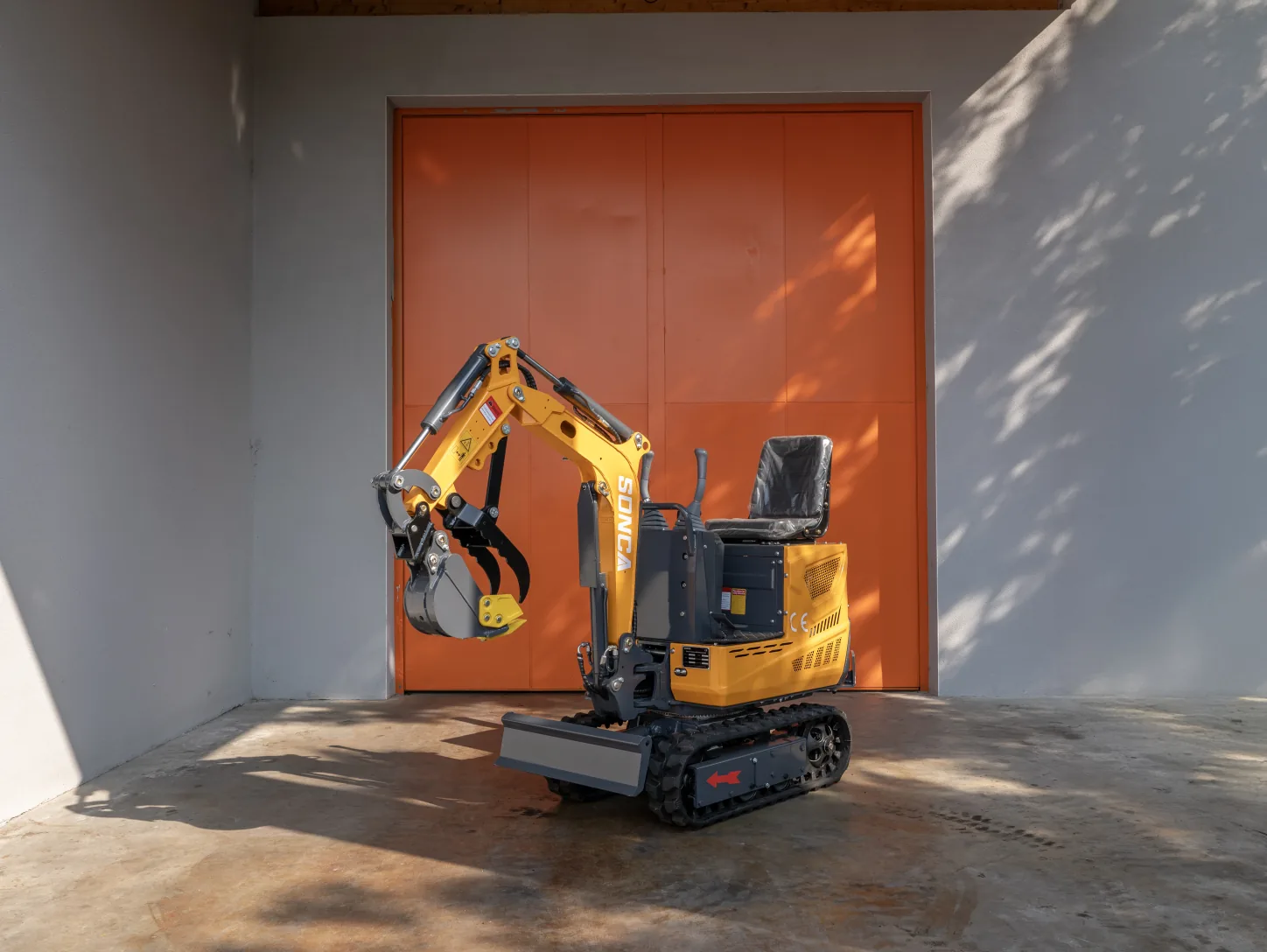
When looking for a compact earthmoving machine, one question keeps coming up: which weight class should you choose? Too light, and the machine lacks strength and stability; too heavy, and it becomes difficult to transport and manoeuvre on small plots. The 1.5-tonne mini excavator answers precisely this dilemma. It is today one of the most sought-after categories, both by homeowners landscaping their land and by building and landscaping tradespeople.
In this guide, we explain why this weight class often represents the best compromise between versatility, working capacity, ease of transport and budget.
An ideal market position
Mini excavators fall into several weight classes, generally from under 1 tonne (micro excavators) up to 5 or 6 tonnes for the largest models in the compact category. Each segment meets specific needs.
- Under 1 tonne: highly manoeuvrable, they can get almost anywhere but offer limited digging depth and breakout force. Ideal for small one-off jobs.
- Around 1.5 tonnes: the balance point. Stable and powerful enough to dig efficiently, while remaining transportable on a trailer accessible to the general public.
- 2.5 to 3.5 tonnes and above: more power and autonomy, but more restrictive transport and a higher price.
The 1.5-tonne machine therefore sits right at the market's centre of gravity. It retains the compactness of a micro excavator while gaining significantly in performance. For many users, it is the first machine you never need to oversize or underestimate.
What a 1.5-tonne machine can really do
The great strength of a mini excavator in this range is its ability to tackle varied tasks one after another without straining. In practice, it is perfectly suited to:
- digging trenches for utilities (water, electricity, drainage);
- preparing light foundations and terraces;
- earthworks for access ways, platforms or small paths;
- removing tree stumps and clearing land;
- digging ponds and small swimming pools;
- loading rubble and soil with a suitable bucket.
Thanks to its mass, it offers better stability than a micro excavator during breakout efforts, and a digging depth sufficient for most common domestic and professional jobs. The offset boom allows digging right up against walls and fences, a valuable asset in urban settings or on narrow plots.
The track undercarriage, often with variable width, allows passage through standard gateways and then widening of the base once on site, for greater stability. This versatility explains why the 1.5-tonne class is so appreciated. To explore the real capabilities according to the tasks, see our guide on earthmoving with a mini excavator.
Discover our range of mini excavators
Compact models from €4,125 excl. VAT, directly imported and covered by a 2-year warranty.
Simplified transport and logistics
This is one of the decisive arguments in favour of the 1.5-tonne machine: its mobility. With such a weight, the machine remains transportable on a suitable plant trailer, towable by many utility vehicles and some 4x4s, subject to complying with the gross vehicle weight rating and licence rules.
This logistical autonomy changes everything day to day. You are not dependent on a haulier to move your machine from one site to another, and you control your costs and deadlines. For a multi-site tradesperson, it saves considerable time; for a homeowner, it guarantees being able to move the machine without complex logistics.
At CZN, we offer precisely these plant trailers in 1.5 T and 2.7 T versions designed to accompany these machines. It is essential to check that the combined weight of trailer + machine remains compatible with your towing vehicle and your licence. A 1.5-tonne machine offers a flexibility here that heavier models quickly lose.
Uses: homeowners and tradespeople
The strength of this category is that it speaks to two very different audiences with converging needs.
For homeowners
A homeowner landscaping their land will find in the 1.5-tonne machine a tool capable of carrying out a complete project: servicing, creating a driveway, laying utilities, digging a pond or preparing a terrace. Where renting quickly becomes expensive on long jobs, buying a compact machine can prove more cost-effective, while remaining resaleable afterwards. To help you decide, our guide on buying or renting a mini excavator sets out the right benchmarks.
For tradespeople
Landscapers, groundworkers, plumbers and bricklayers appreciate the versatility of this class: it reaches difficult terrain, enclosed gardens and constrained urban areas, while offering enough output to be profitable. Combined with attachments such as various buckets, a hydraulic breaker or an auger, it becomes a true do-it-all machine. For a tradesperson, it is often the first machine purchased, the one that covers 80% of routine jobs.
Price and budget to plan for
Budget is logically a central criterion. At CZN, direct importing allows us to offer new mini excavators from €4,125 excl. VAT for the most compact models, with a gradual step up depending on tonnage, engine and equipment.
A 1.5-tonne mini excavator sits above entry-level micro excavators, but remains far more affordable than machines of 3 tonnes and above. You should think in terms of overall cost rather than purchase price alone:
- the price of the machine and its attachments;
- transport (trailer, and possibly a towing vehicle);
- routine maintenance (filters, oils, greasing);
- the depreciation on resale, generally limited on well-maintained machines.
For a detailed analysis of the price ranges and the factors that make rates vary, our dedicated guide on the price of a mini excavator will help you frame your budget without unpleasant surprises. Note also that financing via Sofinco is possible to spread the investment over time; details are on our financing page.
Choosing the right 1.5-tonne mini excavator
Not all machines in this class are equal. Before deciding, a few points deserve your attention:
- The engine. Laidong engines come as standard on our machines, with the Kubota option available to order for those who prefer it. Each solution has its advantages; we compare them in our guide Laidong or Kubota.
- The useful specifications: digging depth, variable undercarriage width, offset boom, hydraulic flow for attachments.
- The availability of aftersales and parts. A machine imported without technical support in France can quickly become a headache. CZN provides aftersales in France and a 2-year warranty.
- New or used. A refurbished used machine can be an excellent entry point; our used mini excavators are inspected across 50 points and covered by a 6-month warranty.
The best approach remains to start from your actual project: the nature of the work, frequency of use, access to the site and budget. Our complete guide on how to choose your mini excavator guides you step by step through this process and helps you confirm whether the 1.5-tonne class is indeed the one you need.
In summary, the 1.5-tonne mini excavator fully deserves its reputation as a good compromise: it combines manoeuvrability, serious working capacity, self-sufficient transport and a controlled price. For a first purchase or a versatile everyday machine, it is often the most rational choice.
Unsure which model suits your project?
Our advisers can guide you from our Toulouse showroom or remotely, with no obligation.