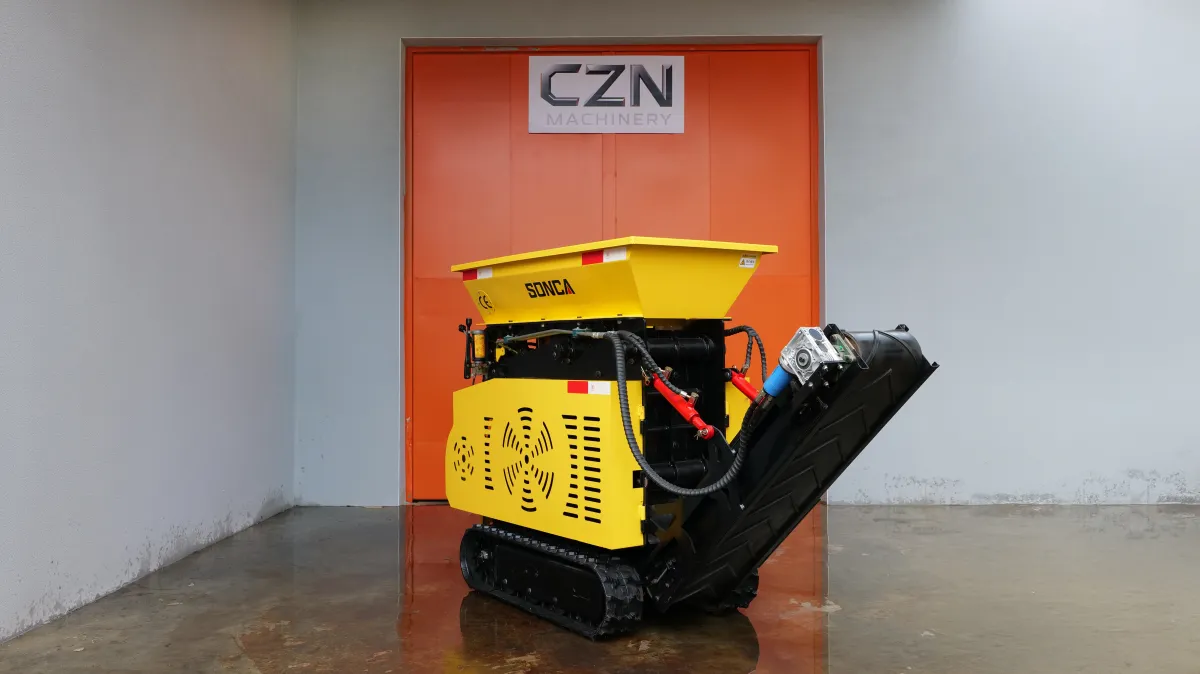
On a demolition, renovation or earthworks site, rubble piles up fast: concrete slabs, brick walls, stone, asphalt. Traditionally, this inert waste goes into a skip and off to a recycling facility or landfill, at your expense. Yet a large part of these materials can be given a second life directly on site, thanks to a site crusher. The idea is simple: instead of paying to haul it away and then buy aggregate back, you turn the rubble into reusable material on the site itself.
The keyword site rubble crusher covers an increasingly common economic and ecological logic, including among tradespeople and small businesses. Let's look at how to make the most of it in practical terms.
Why recycle your rubble on site
Recycling inert waste at the very place it is produced addresses three major challenges.
Reducing transport costs. Every lorry or skip round trip means a cost in hire, fuel and time. The further the site is from a treatment facility, the higher the bill climbs. By crushing on site, you eliminate a large part of these back-and-forth trips.
Avoiding landfill charges. Sending rubble to landfill is charged by the tonne, and rates are rising steadily under the pressure of environmental taxation. Concrete reused on site no longer costs anything to dispose of: it becomes a resource.
Reusing free aggregate. The crushed product serves as backfill, a foundation layer, a formation layer or draining material. You save on buying new aggregate, the prices of which are also on the rise. The site's carbon footprint is noticeably improved, an argument increasingly valued in both public and private contracts.
Which materials to crush
A crusher designed for site rubble handles most inert construction waste:
- Concrete, reinforced or not (slabs, foundations, posts) — remember to remove exposed rebar where possible;
- Bricks and blocks from the demolition of walls or partitions;
- Natural stone, rubble stone, blocks from excavation;
- Tiles and ceramics in moderate quantities;
- Asphalt and bituminous materials within certain limits.
On the other hand, a crusher is not designed for wood, plaster, solid metal or hazardous waste. Sorting the rubble beforehand therefore remains essential, both to protect the machine and to obtain clean, reusable aggregate.
How a jaw crusher works
The jaw crusher is the most widespread model for site rubble, because it is robust, simple and well suited to hard materials such as concrete and stone.
Its principle relies on two jaws: one fixed and one moving, driven by a back-and-forth motion. The rubble fed into the crushing chamber is gradually broken down by compression until it passes through the lower opening, whose gap determines the size of the aggregate produced. The narrower the gap, the finer the final material.
Adjusting this opening therefore allows you to produce different grain sizes depending on the use: a coarse aggregate for backfill, a more regular calibre for a foundation layer. Feeding is generally done with a bucket: you load the rubble into the hopper with a mini excavator or loader bucket, then the machine does the rest.
Need a robust crusher for your rubble?
Discover the CZN jaw crusher and our other specialist site machines.
The savings achieved
Calculating a crusher's cost-effectiveness rests on adding up several areas of savings. To illustrate, here are the main levers to compare between conventional haulage and on-site recycling.
| Item | Conventional haulage | On-site crushing |
|---|---|---|
| Rubble transport | Skip hire + lorry round trips | Eliminated or reduced |
| Landfill charges | Charged by the tonne | Eliminated |
| Purchase of new aggregate | By the tonne, delivery included | Aggregate produced free of charge |
| Site time | Waiting for round trips | Material available immediately |
On a site generating several dozen tonnes of rubble, the cumulative effect of these savings can be significant. Cost-effectiveness depends on the volume handled, the distance to treatment facilities and how often the machine is used. For a business running one demolition or earthworks job after another, the investment pays for itself all the faster. If the volume of your activity doesn't justify a purchase, financing solutions let you spread the cost.
The steps of on-site recycling
Recycling your rubble on site follows a logical sequence that is easy to implement with compact equipment.
- Sorting the materials. Separate the inert waste (concrete, brick, stone) from the rest. Remove rebar, wood, plastic and plaster.
- Building up a stock. Gather the rubble into accessible piles, close to where the crusher will be positioned.
- Feeding the crusher. Load the rubble into the hopper using a mini excavator or a mini loader. Meter the feed so as not to overload the chamber.
- Collecting the aggregate. The crushed material comes out calibrated, ready to be moved or stored.
- Reuse. Spread the aggregate as backfill, a formation layer or a draining layer, depending on the grain size obtained.
The benefit of a coherent fleet of compact machines becomes clear here: the same mini excavator used for demolition or earthworks feeds the crusher, then spreads the recycled aggregate. A mini dumper can round out the set-up to move materials over short distances.
Regulations and best practice
On-site crushing is still regulated. A few points of caution deserve your attention before you get started.
Inert waste only. On-site recycling applies only to uncontaminated inert waste. A preliminary assessment is necessary, in particular to detect any pollutants (asbestos, hydrocarbons) in older buildings. Where suspect materials are present, they must go through a specialist channel.
Nuisance and neighbours. Crushing generates noise and dust. Provide for spraying water if necessary to limit dust, observe permitted working hours and inform neighbours on urban sites.
Use of the recycled aggregate. The material produced must match the intended use. For simple backfill or a non-structural foundation layer, recycled aggregate is perfectly suitable. For more demanding applications, check the technical characteristics required.
Traceability. Even when recycled on site, volumes of inert waste must be tracked as part of site waste management. Keep your supporting documents.
The CZN crusher
CZN Machinery offers a jaw crusher within its range of other machines, alongside the radio-controlled forestry mulcher. Designed for site rubble (concrete, brick, stone), it allows tradespeople, landscapers and small construction firms to make use of their inert waste without systematically relying on an external facility.
Like all our machines, it benefits from the advantages of direct import: competitive prices, a 2-year warranty, delivery anywhere in France and France-based aftersales. Our Toulouse showroom welcomes visitors who wish to see the machines before deciding, and our team has advised more than 5,500 customers since 2019.
Paired with a mini excavator from €4,125 excl. VAT for feeding and earthworks, the crusher completes a coherent and versatile fleet of compact machines. You thus have a self-contained chain, from demolition to reuse of the aggregate.
To transport these machines between your sites, also consider our plant trailers, available in 1.5 T and 2.7 T versions.
Planning a rubble recycling project?
Our advisers will help you size the right equipment to suit your site volume.
Recycling your rubble on site is no longer reserved for large projects. With a suitable crusher and a few good practices, any business can turn a load of waste into a free resource, reduce its costs and lighten its environmental footprint. An investment that combines economic logic with ecological responsibility.