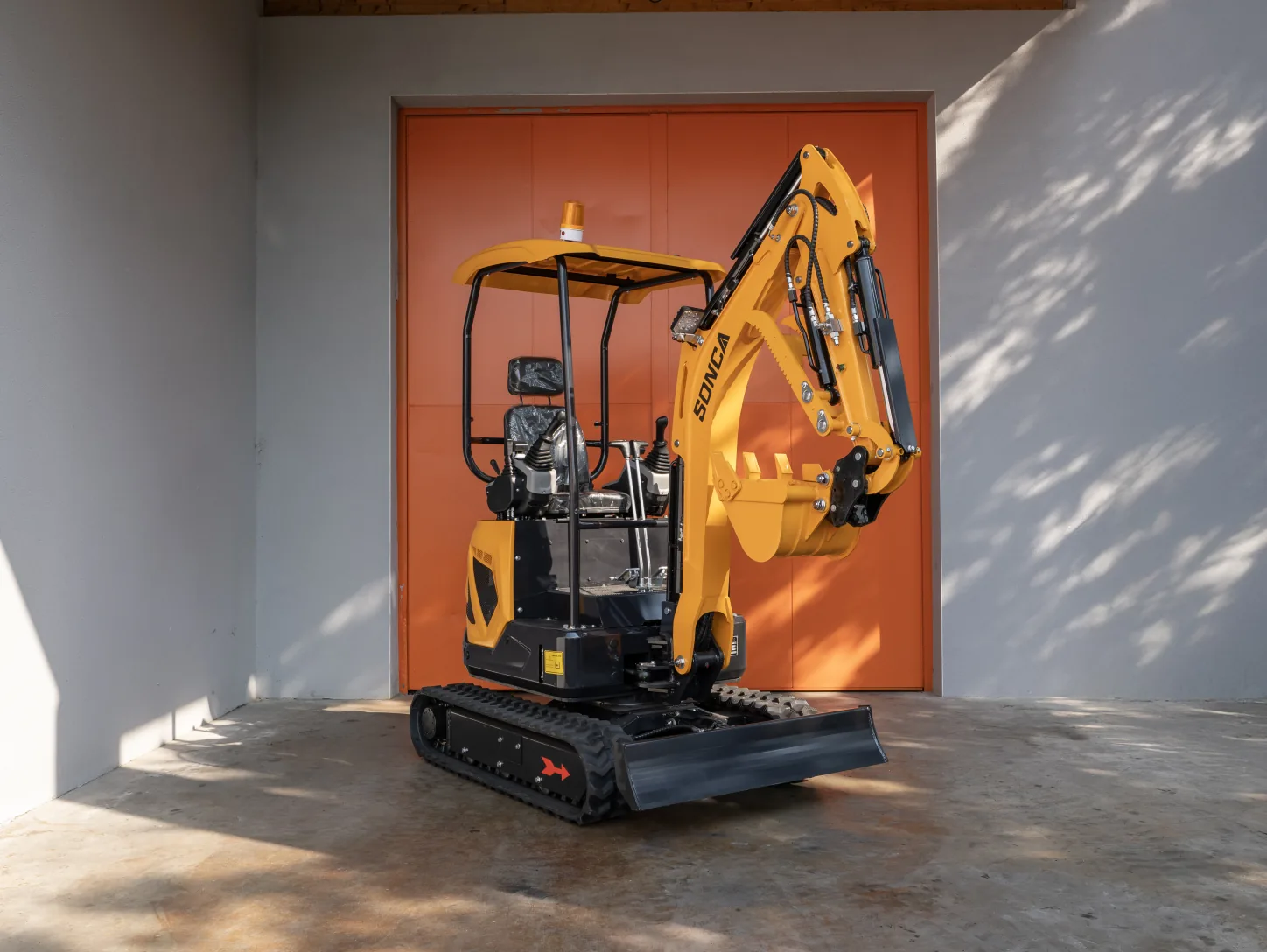
The mini excavator is no longer reserved for construction professionals. More and more private individuals are kitting themselves out to level a plot, dig a trench, prepare for a swimming pool or landscape a garden. But one question always comes up before buying: do you need a licence or training to operate a mini excavator as a private individual? The answer is broadly reassuring, provided you understand the legal framework properly. Let's set things out clearly.
Do private individuals need a licence?
Let's start with the most direct question: no, no driving licence is required to use a mini excavator on private land. A mini excavator is not a road vehicle: it's a construction machine that moves on tracks, at low speed, and is not designed to travel on public roads.
In practical terms, if you own a plot of land and carry out your own work there, you can operate your mini excavator without a car driving licence, without a registration document and without registering the machine itself. This is one of the major advantages of these compact machines for private individuals.
This freedom comes down to the nature of the usage: French regulations (notably the Labour Code) strictly govern the professional use of machinery, but leave the private individual free to act on their own private property, as long as they don't employ anyone.
Is a CACES certificate compulsory?
The CACES (Certificate of Aptitude for Safe Operation) is often presented as the famous "mini excavator licence". In reality, it isn't a licence in the road sense, but a certificate of competence issued after training and a test.
The key point to remember: the CACES is only compulsory in a professional context. It applies to employees who use a machine as part of their job. It is the employer who must ensure that their staff are trained and authorised to operate it.
For a private individual working at home, for their own personal use and without any employment relationship with an employer, the CACES is not required by law. You can therefore buy and use a mini excavator without holding this certificate.
Be aware, however, of a few important nuances:
- If you employ someone (even occasionally, even a paid relative) to operate your machine, you enter a professional context and the training obligations apply.
- If you hire a mini excavator, some hire companies may ask for a certificate or have you sign a liability waiver.
- If you work on a third party's land or within an organised association setting, the line with professional use can become blurred.
To understand everything about this certificate, its content and the cases where it becomes necessary, see our dedicated guide: everything you need to know about the mini excavator CACES.
Unsure about your situation?
Our advisers will explain exactly what your obligations are according to your project and the type of machine.
Travelling with your mini excavator
The key distinction lies between use on private land and travel on public roads. As long as your mini excavator stays on your property, no licence is required.
However, as soon as it comes to crossing or using a road open to traffic, the situation changes. Most mini excavators intended for private individuals are not type-approved to drive on public roads. The simplest and most common solution is therefore to transport the machine on a plant trailer.
This is where the standard driving licence comes in: the choice of trailer and the total weight of the combination determine the licence category required (B, B96 or BE). We cover all of this in our guide on transporting a mini excavator on a trailer.
To transport a compact machine entirely legally, CZN offers plant trailers in 1.5 T and 2.7 T versions, suited to the various operating weights of our mini excavators.
| Situation | Licence required? | CACES required? |
|---|---|---|
| Work on my own private land | No | No |
| Transport on a trailer (road) | Yes (B, B96 or BE) | No |
| Use with an employee | Depending on the machine | Yes |
| Professional worksite | Depending on the machine | Yes |
Safety and best practices
The absence of a legal obligation never removes the need for caution. A mini excavator, even a compact one, remains a powerful machine capable of moving several hundred kilos of earth. Here are the common-sense rules you must absolutely follow:
- Locate buried utilities before digging (electricity, gas, water, telecoms). A works declaration (DT-DICT) can be useful even for a private individual to avoid a serious accident.
- Wear PPE: safety footwear, gloves, goggles and a helmet if necessary.
- Check the stability of the ground and work on a level surface as far as possible. Use the blade to stabilise the machine.
- Keep people away from the rotation and arm working area.
- Do not overload the bucket and avoid sudden movements that unbalance the machine.
- Beware of slopes: go up and down in line, never across a pronounced gradient.
Following these principles prevents the vast majority of incidents. To go further, our guide on using a mini excavator details the technical actions and basic manoeuvres step by step.
Why training is still worthwhile
Even without an obligation, taking a course or teaching yourself seriously offers real advantages for a private individual:
- Gaining confidence from the very first hours of handling.
- Working faster and more cleanly, by mastering the coordination of the levers.
- Protecting the machine by avoiding mistakes that wear out the hydraulic components and tracks.
- Reducing the risk of accidents and material damage.
Many beginners dread the complexity of operating it. In practice, the controls of a modern mini excavator are intuitive: two joysticks handle most of the movements. A few hours are generally enough to carry out simple work. If you're still hesitating between buying and hiring for a one-off job, read buying or hiring a mini excavator.
CZN support
At CZN Machinery, we support private individuals at every stage. A direct importer based in Toulouse since 2019, we offer brand-new mini excavators from €4,125 excl. VAT, with a range designed for accessible use: from the SJW-06 petrol micro excavator (660 kg) to more robust models such as the SJW-18 PRO (1,271 kg) or the XC22 PRO V2 (2,000 kg).
Our strengths for a private buyer:
- 2-year warranty (24 months) on new machines.
- Delivery throughout France and France-based aftersales.
- Showroom in Toulouse to see and try out the machines.
- Personalised advice on choosing the model to suit your land and your work.
- Sofinco financing available to spread your investment (see our financing page).
To choose the machine suited to your needs and your budget, our guide on how to choose your mini excavator helps you compare tonnages and uses. And if you're looking at a refurbished second-hand machine, ours undergo a 50-point inspection and come with a 6-month warranty.
Ready to equip yourself?
Discover our range of compact mini excavators for private individuals, delivered throughout France.
Frequently asked questions
Can a private individual really operate a mini excavator without any qualification?
Yes, on their private land and for their own work, no licence or CACES is legally required. Only caution and compliance with safety rules are essential.
Does the CACES become compulsory if I lend my mini excavator to a friend?
In a strictly friendly and unpaid context, the law imposes nothing in particular, but you remain responsible as the owner. As soon as there is payment or a working relationship, professional obligations apply.
Do you need a licence to tow the trailer carrying the mini excavator?
Yes. Depending on the total weight of the combination, a B, B96 or BE licence is required. Check the trailer's maximum authorised weight (PTAC) and the operating weight of your machine.
Is CACES training of any benefit to a private individual?
It isn't compulsory, but it provides genuine technical mastery and makes your practice safer. For most private individuals, getting a good handle on the machine and reading our guides is enough to start out with confidence.
In summary: using a mini excavator as a private individual on your own property requires neither a licence nor a CACES. Focus on safety, choose a suitable machine and don't hesitate to contact us for guidance on your project.