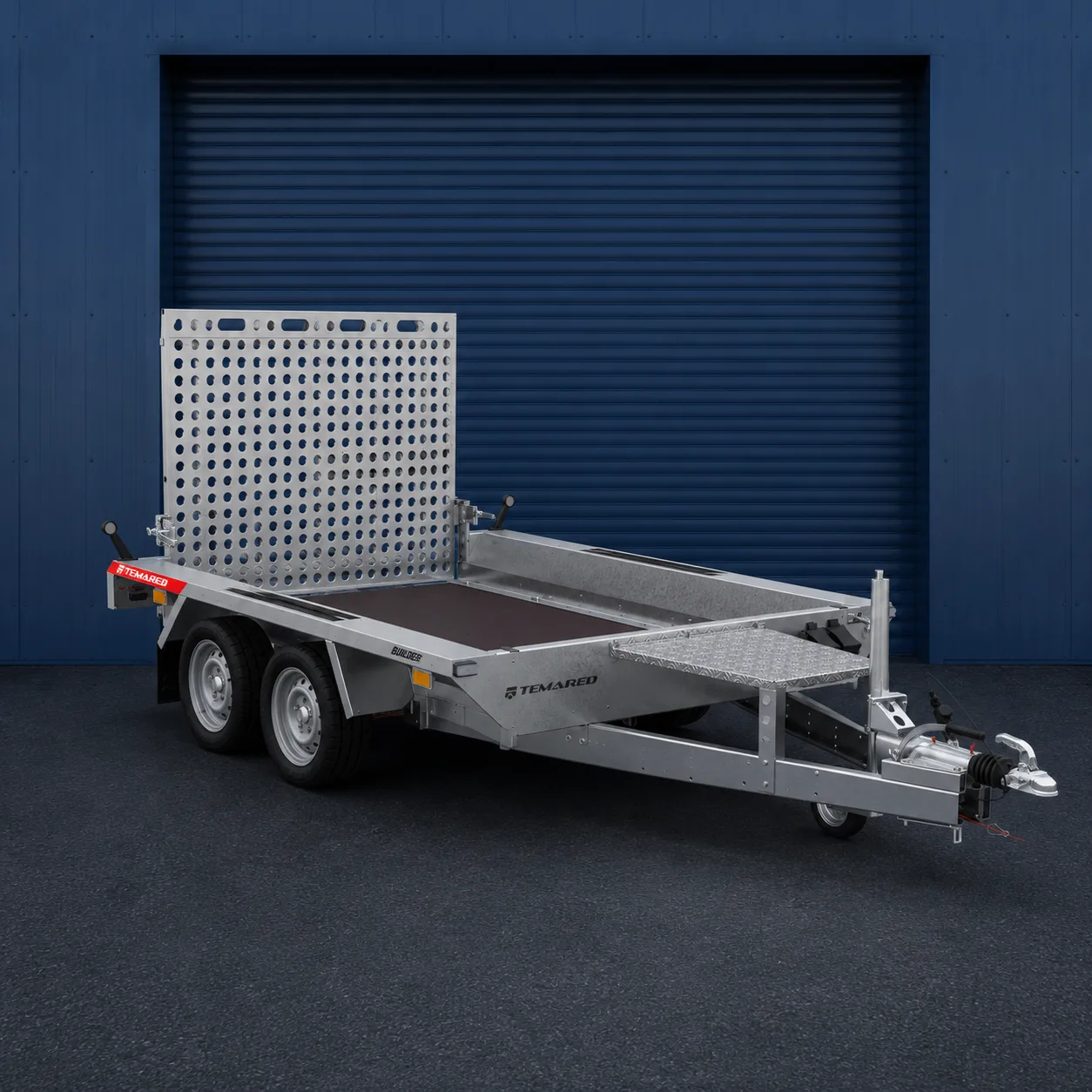
Transporting a mini excavator on a trailer is a common operation, but a regulated one. Between the actual weight of the machine, the gross vehicle weight of the road combination, the licence category required and the lashing rules, several parameters have to line up for you to drive within the law. A miscalculation and you expose yourself to a fine, having the vehicle impounded, or even an accident. This guide sets everything out so you can transport your mini excavator with peace of mind.
Understanding GVW and actual weight
First and foremost, you need to think in terms of total weight. Three concepts are essential:
- The weight of the mini excavator: a micro excavator starts at around 1 tonne, the 1.5 to 2 tonne models are the most common among private individuals and tradespeople, and machines of 2.5 tonnes and above are aimed at earthmoving professionals.
- The trailer's GVW (Gross Vehicle Weight): this is the limit beyond which you can no longer load, trailer included.
- The GTW (Gross Train Weight): the maximum weight of the car + loaded trailer combination, shown on the towing vehicle's registration document.
The golden rule: the weight of the machine + the unladen weight of the trailer + accessories (buckets, oils, fuel) must never exceed the trailer's GVW. Also bear in mind any additional buckets or a hydraulic attachment left on the machine, which add to the overall weight.
Category B or BE licence: what does the law say?
The licence category depends on the trailer's GVW and the total weight of the combination. Here are the most common cases:
| Situation | Licence required |
|---|---|
| Trailer ≤ 750 kg GVW | Category B licence (whatever the towing vehicle, within the GTW limit) |
| Trailer > 750 kg but combination (car + trailer) ≤ 3,500 kg GVW | Category B licence |
| Combination between 3,500 kg and 4,250 kg | Category B licence with B96 training (7 hrs) |
| Combination > 4,250 kg and up to 7,000 kg | Category BE licence |
In practical terms, to transport a 1.5 tonne mini excavator on a suitable trailer with an ordinary car, you quickly exceed the combined 3,500 kg: the B96 training or the BE licence then becomes necessary. Always check the sum of the GVWs (the towing vehicle's + the trailer's): it is this figure, and not the actual weight carried, that determines the regulations.
If you're unsure which model suits your use and your licence, our guide to the 1.5 tonne mini excavator details the most common weight/versatility trade-offs.
Need a trailer suited to your machine?
1.5 T and 2.7 T plant trailers, delivered in France with a 2-year warranty.
Choosing your plant trailer
A plant trailer is not simply a reinforced luggage trailer. It must have a hard-wearing bed, loading ramps and anchor points dimensioned for the weight and vibrations of a construction machine. At CZN, two formats cover the vast majority of needs:
- The 1.5 tonne trailer: ideal for micro excavators and small models up to around 1.3-1.4 tonnes, with the essential safety margin. It can often still be towed with a category B licence depending on the vehicle.
- The 2.7 tonne trailer: designed for heavier mini excavators (roughly 1.5 to 2.5 tonnes), accessories included. This is the choice of tradespeople and professionals who move their machine regularly.
The right approach: choose the trailer based on the heaviest machine you will transport, with a margin. A trailer with too tight a GVW will force you to remove accessories or watch every kilo. You'll find the precise specifications on the plant trailers page.
Also check for aluminium or steel anti-slip ramps, a winch system or lashing straps, and compliant lighting. A new, type-approved trailer saves you nasty surprises during a roadworthiness inspection.
Lashing: the four-point rule
Faulty lashing is one of the main causes of accidents when transporting machinery. The regulations require that the load cannot slide, tip or fall. For a mini excavator, always apply the following:
- A minimum of four lashing points: two at the front, two at the rear, forming an angle that blocks longitudinal and lateral movements.
- Type-approved straps or chains whose capacity (LC, shown on the label) suits the weight of the machine. Never improvise with luggage straps.
- Lowering the arm and bucket onto the bed, engine off, parking brake applied.
- A weight distribution that respects the load on the towbar (generally between 4 and 7% of the total weight, without exceeding the towball limit).
After a few kilometres, stop to recheck the tension of the straps: vibrations and settling can loosen them.
Loading and unloading safely
Loading is the trickiest moment. Position the trailer on flat, stable ground, unhitched or hitched according to the manufacturer's recommendations, and chock the wheels. Deploy the ramps, checking they are properly locked.
Drive the mini excavator up slowly, in line, avoiding jerky movements. A good practice is to drive up tracks-first if weight distribution requires it, or forwards depending on the machine's geometry: consult your machine's manual. Use the arm and bucket as support only if the manufacturer allows it.
Mastering the movements of the machine is essential: if you're a beginner, our mini excavator operating guide covers the right driving techniques. Remember too that a CACES may be required in a professional context, even for simple manoeuvres.
Traffic rules and checks
Once on the road, several rules apply to a combination towing a trailer:
- Reduced speed limits depending on the trailer's GVW (often 80 or 90 km/h on roads, 90 to 110 km/h on motorways): observe the signage and the details on the registration certificate.
- The trailer's own registration as soon as its GVW exceeds 500 kg, with its own plate and certificate.
- Insurance: a trailer over 750 kg must be declared to your insurer.
- Load signage if the machine exceeds the trailer's dimensions (regulatory signs).
- Roadworthiness inspection for trailers whose GVW requires it under the regulations in force.
In the event of a check, all the documents (appropriate licence, registration document, insurance certificate) and compliant lashing are inspected. It is better to plan ahead than to risk having the vehicle impounded.
If you only transport your machine occasionally, compare the cost of buying a trailer with that of hiring a mini excavator delivered to site, or with subcontracting the transport. For regular use, a trailer quickly pays for itself.
In summary
Transporting your mini excavator on a trailer rests on three pillars: rigorous weight calculation (GVW and GTW), the right licence (B, B96 or BE depending on the combination) and flawless lashing. The choice of trailer must always start from the actual weight of your machine, accessories included, with a safety margin.
CZN Machinery offers 1.5 T and 2.7 T plant trailers suited to its entire range of mini excavators, delivered in France and guaranteed for 2 years. A question about the compatibility between your machine, your vehicle and your licence? Contact our team in Toulouse for tailored advice.