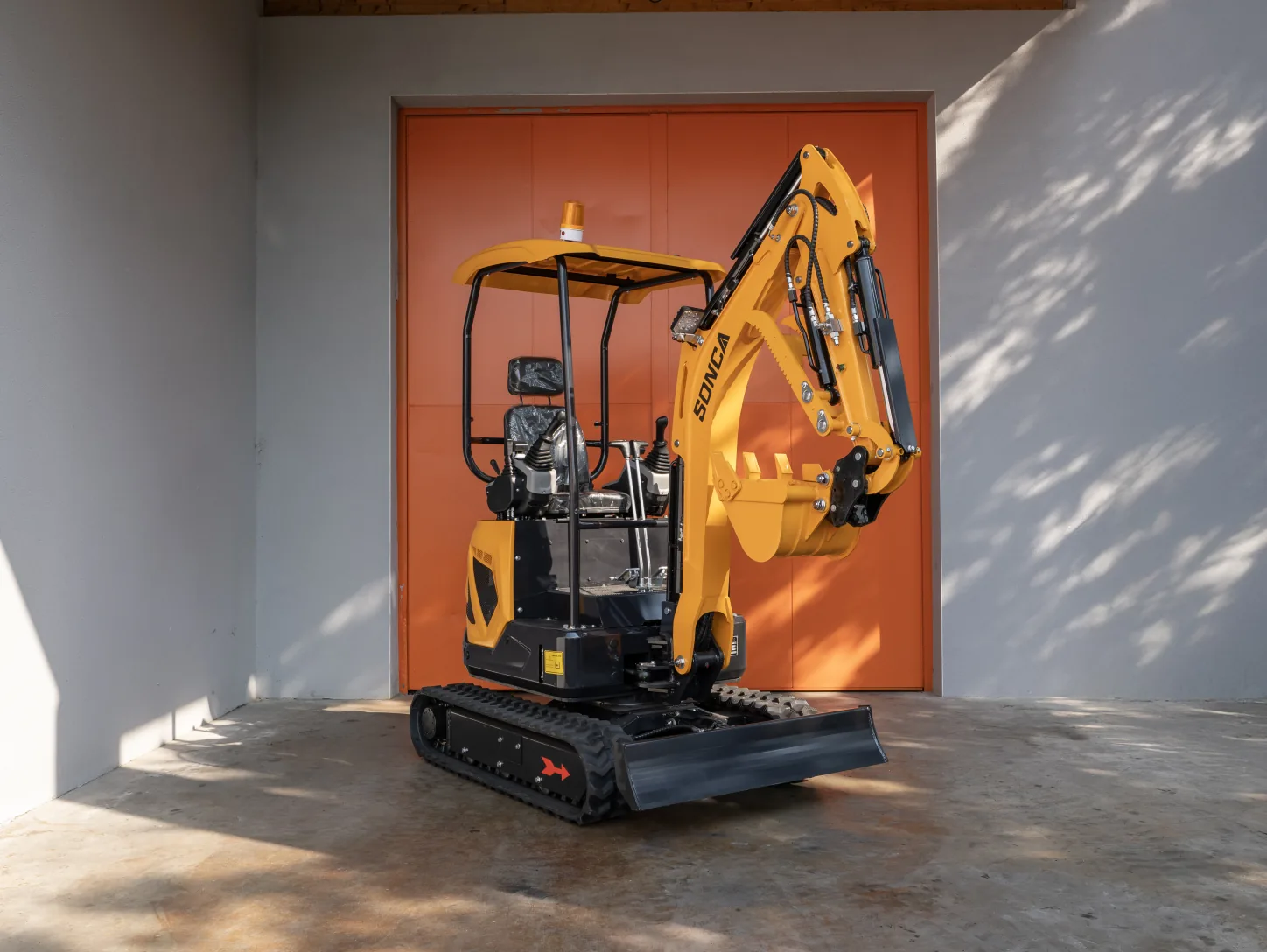
It's one of the most frequent questions we're asked at our Toulouse showroom: should you invest in a mini loader or a mini excavator? Both machines are compact, manoeuvrable and suited to tight sites, but they don't do the same job. One excels at digging, the other at loading and transporting. Choosing the right one depends above all on the nature of your tasks. This guide helps you see clearly, understand how the two machines complement each other, and steer your decision.
Two different ways of working
Before comparing technical specifications, you need to understand one essential thing: mini excavators and mini loaders are based on two opposing principles. The mini excavator is an earthmoving machine: it digs, extracts and moves earth thanks to an articulated arm and a bucket oriented towards the operator. The mini loader, on the other hand, is a handling machine: it picks up, carries and tips materials using a front bucket or attachments, moving forward towards the load.
Put simply: the mini excavator pulls towards itself, the mini loader pushes ahead of it. This fundamental difference governs all possible uses. A mini excavator will never efficiently replace a loader for feeding a truck with rubble, and a loader will never dig a clean trench for a buried network.
The mini excavator: digging and earthmoving
The mini excavator is the go-to machine for all work involving removing material from the ground. Its articulated hydraulic arm, fitted with a digging bucket, allows precise excavation at varying depths depending on the model and size of the machine.
Typical uses are numerous:
- Digging trenches for networks (water, electricity, drainage);
- Foundations and slab earthmoving;
- Digging a swimming pool or pond;
- Levelling, excavation and landscaping work;
- Stump removal and agricultural work thanks to attachments.
The compact range covers a wide spectrum of needs. The smallest, such as the petrol micro excavator SJW-06 (660 kg operating weight), fit through a garden gate and suit private individuals. Intermediate models such as the SJW-18 PRO (1,271 kg) or the XC17 PRO V2 (1,450 kg) cover most professional sites, while the XC22 PRO V2 (2,000 kg) or the SJW-25 (1,725 kg) tackle more demanding work. To understand how to assess these characteristics, consult our guide on how to choose your mini excavator.
One of the great strengths of the mini excavator is its versatility through attachments: buckets of various widths, ditching bucket, hydraulic hammer (rock breaker), auger, grapple… Each tool transforms the machine for a new task. Discover the essential attachments to plan for.
Need to dig and move earth?
Explore our range of new mini excavators, from €4,125 excl. VAT, with a 2-year warranty and aftersales in France.
The mini loader: loading and handling
The mini loader (also called a compact loader) is designed to move and load materials in volume. Thanks to its front bucket and traction, it picks up sand, gravel, earth or rubble, transports them over short distances and tips them into a truck, a dumper or a skip.
Its main uses:
- Loading trucks and trailers;
- Moving pallets, cement bags, construction materials;
- Cleaning and rough levelling of platforms;
- Handling in livestock farming (manure, fodder);
- Snow clearing and sweeping with the appropriate attachments.
Like the mini excavator, the mini loader gains enormously in versatility thanks to interchangeable equipment: pallet forks, sweeper, blade, multi-purpose bucket. To learn all about how it works, its dimensions and the criteria for choosing one, read our complete guide to the mini loader.
Its strength lies in its load capacity and speed of cycles: where a mini excavator would require several laborious manoeuvres to load a truck, the loader completes back-and-forth trips efficiently. On the other hand, it doesn't dig: at best it can scrape the surface of the ground, without reaching any depth.
Comparison table
| Criterion | Mini excavator | Mini loader |
|---|---|---|
| Main function | Dig, extract, earthmoving | Load, transport, handle |
| Movement | Articulated arm, pulls towards itself | Front bucket, pushes forward |
| Working depth | Yes, variable depending on the model | Surface only |
| Loading capacity | Limited, slow | High, fast |
| Digging precision | Excellent | None |
| Travel | Slow (tracks) | Fast (wheels or tracks) |
| Attachments | Buckets, hammer, auger, grapple… | Forks, sweeper, blade, multi-bucket… |
| Ideal site | Trenches, foundations, swimming pool | Loading, handling, cleaning |
This table sums up the essentials: the two machines are complementary rather than competing. The choice depends on the dominant task in your activity.
Complementary on site
Ideally, the mini excavator and mini loader work together. On a complete earthmoving site, the mini excavator digs and extracts the spoil, while the loader clears away and loads the earth into a truck or a mini dumper. It's the classic trio of construction sites: excavator to dig, dumper to transport in tight areas, loader to feed the transport.
Many professionals start by acquiring a mini excavator, which remains the most versatile machine for the majority of earthmoving work, then add a loader to their fleet when the volume of handling justifies it. A private individual or tradesperson who only loads occasionally can make do with a mini excavator and its bucket for both functions, accepting lower efficiency when loading.
Don't forget the logistics either: to transport your machines from one site to another, a machine-carrying trailer suited to the weight of the machine is essential. We offer 1.5 T and 2.7 T models depending on the size to be transported.
How to choose based on your profile
Ask yourself the central question: am I digging or am I loading? Here are some pointers based on the most common profiles.
You dig above all
Trenches, foundations, swimming pool, drainage, landscaping with excavation: the mini excavator is indispensable. No loader could carry out these tasks. It's also the most logical choice for a first machine, as its versatility covers more situations. Private individuals and landscapers will lean towards a compact model, network companies towards an intermediate size.
You handle materials above all
Repeated loading of trucks, moving pallets, managing material stocks, agricultural handling work: the mini loader is the clear choice thanks to its speed and capacity. It saves considerable time where the excavator would be cumbersome.
You do both regularly
If your activity combines earthmoving and intensive loading, considering both machines is often more cost-effective in the long run than multiplying manoeuvres with a single machine. For occasional volumes, a well-equipped mini excavator on its own remains sufficient.
In all cases, consider the training and regulatory requirements (operator certification in a professional context) before putting the machine into service.
Budget and practical considerations
On the investment side, new CZN mini excavators start from €4,125 excl. VAT, which often makes them the first machine acquired by a tradesperson or private individual. The price then varies according to size, engine and attachments. To estimate a realistic budget, consult our dedicated guide on the price of a mini excavator.
A few practical points not to be overlooked, whichever machine you choose:
- Weight and transport: check the compatibility between the machine's operating weight and your means of transport;
- Maintenance: oil changes, greasing and monitoring of tracks or tyres determine longevity — see our guide on mini excavator maintenance;
- Warranty and aftersales: our machines come with a 24-month warranty and aftersales service in France;
- Financing: a solution via Sofinco is available to spread the investment, detailed on our financing page.
If your need is occasional, the question of buying or renting is also worth raising before you commit.
Conclusion
Between a mini loader or a mini excavator, there's no better machine in absolute terms: there's the machine suited to your site. The mini excavator digs and moves earth with precision; the mini loader loads and handles with speed. For the vast majority of users starting out, the mini excavator remains the most versatile choice, with the loader coming to complete the fleet when handling volumes require it.
Still unsure? Our team at the Toulouse showroom will advise you based on your activity and your sites. Explore our range of mini excavators and mini loaders, or contact us directly.
Unsure which machine suits your site?
Tell our advisers about your project: they'll steer you towards the most suitable machine.