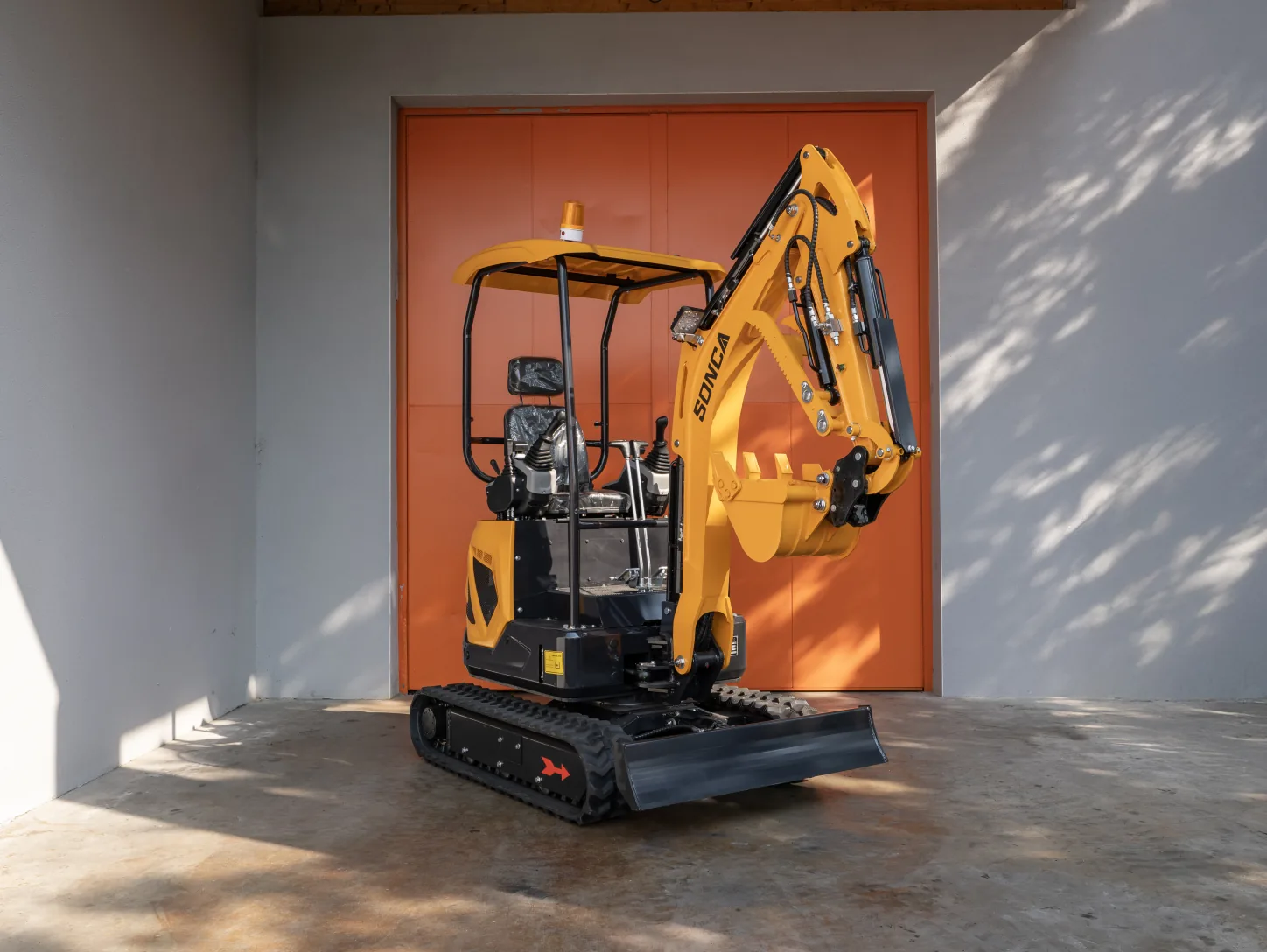
Digging foundations with a mini excavator is one of the most common operations on a construction, extension or renovation site. Whether it's strip footings for a load-bearing wall, ground beams on piles or a full crawl space, the compact machine lets you work with precision even in tight spaces. You still need to choose the right tonnage and follow a rigorous method to achieve regular trenches, at the correct depth and to the right dimensions.
This guide details the types of foundations that are commonly dug, the tonnage suited to each configuration, the achievable depths and the step-by-step working method. The aim: to help you properly scope your project before hiring or buying.
Why use a mini excavator for foundations
The mini excavator has established itself as the go-to tool for foundation work on detached houses and small buildings. Its strengths are numerous:
- Compactness: it can access enclosed plots, narrow sites and already-built areas where a full-size site excavator wouldn't fit.
- Precision: the articulated arm lets you follow a string line and dig clean trenches with straight walls.
- Versatility: with several buckets, the same machine digs narrow trenches for footings and wide excavations for a crawl space.
- Productivity: where manual earthworks would take days, a mini excavator completes the excavation in a few hours.
To understand the basics of the machine before going further, see our guide what is a mini excavator and our mini excavators page.
Footings, ground beams, crawl spaces: what you'll be digging
Each type of foundation involves a different excavation geometry, and therefore suitable equipment.
Strip footings
These are the continuous trenches that receive the reinforced concrete beneath load-bearing walls. Their width generally varies between 40 and 60 cm depending on the soil survey, for a frost-free depth often between 50 and 90 cm. An earthmoving bucket of 30 to 50 cm is ideal for cutting these trenches without unnecessary over-width, which limits the volume of concrete to pour.
Isolated footings and ground beams
On heterogeneous soil or for a pile-supported construction, you dig localised excavations (pads) connected by ground beams. The mini excavator lets you quickly carry out these localised excavations and the channels that connect the load-bearing points.
The crawl space and excavation
For a crawl space, you need to excavate a wider area over several tens of centimetres, then dig the perimeter footings. Here, a grading bucket (wide and toothless) makes the final levelling easier, while a narrow bucket remains useful for the trenches. The guide mini excavator and earthworks details these excavation operations.
Need advice on scoping your project?
Our team in Toulouse will point you towards the right machine for your foundations.
Which tonnage to choose for foundations
The choice of tonnage depends on the nature of the soil, the target depth and the volume to be removed. For detached house foundations, machines in the 1.8 to 3 tonne class offer the best compromise between power, stability and compactness.
| CZN model | Operating weight | Recommended use for foundations |
|---|---|---|
| Sonca SJW-18 PRO | 1,271 kg | House footings, trenches, loose to medium soils |
| Xcavator XC17 PRO V2 | 1,700 kg | Standard foundations, good all-round compromise |
| Sonca SJW-25 | 1,725 kg | Deeper foundations, compact soils |
| Xcavator XC22 PRO V2 | 2,200 kg | Crawl space, large volumes, difficult ground |
An important point: with Sonca, the number in the name (18, 25) refers to the digging force and not the weight. The SJW-18 PRO thus develops 1.8 t of breakout force for an operating weight of 1,271 kg, and the SJW-25 a force of 2.5 t for 1,725 kg. This detail matters when comparing actual digging capacities.
For a one-off project on loose soil, a machine around 1.3 tonnes is often enough. As soon as the soil becomes compact or stony, or the depth exceeds 1 metre, the stability and power of a 2 to 3 tonne machine make the difference. Our guide how to choose your mini excavator goes deeper into these criteria, as does the page dedicated to the 1.5 tonne mini excavator.
Depth, buckets and attachments
Excavation depth is the central technical criterion for foundations. It must always respect the frost-free depth defined by the soil survey (DTU), so that the concrete is not subjected to frost heave. In temperate zones, you generally go down between 50 and 80 cm; in mountain areas, this depth increases significantly.
Mini excavators in the 1.8 to 3 t class easily reach the common excavation depths of detached houses. For deeper footings or basements, a 2.2 tonne model such as the XC22 PRO V2 offers greater arm reach and stability.
The choice of buckets is decisive:
- Narrow earthmoving bucket (30 cm): footing trenches, saving on concrete.
- Medium earthmoving bucket (40-50 cm): wide footings, ground beams.
- Grading (cleaning) bucket: levelling the excavation bottom and finishing the crawl space.
Also consider a site laser or a staff to check the level of the excavation bottom. Find the useful equipment on our attachments page and in the guide to essential attachments.
Step-by-step method
Here is a typical procedure for digging foundations cleanly.
- Setting out: mark out the line of the walls with string lines and stakes, based on the execution plan. Check the diagonals to ensure square corners.
- Stripping the topsoil: remove the surface layer (20 to 40 cm) and store it aside for reuse.
- Digging the trenches: follow the line working backwards, with the bucket directly below the string line. Maintain a constant depth by regularly checking with the laser.
- Removing the spoil: deposit the soil on one side, far enough from the edge to avoid collapse. A mini dumper makes removal easier for large volumes.
- Finishing the excavation bottom: clean and level the bottom with the grading bucket. The bottom must be flat, clean and at the correct level.
- Checking before pouring: verify dimensions, depth and horizontality before placing the reinforcement and pouring the concrete.
Always work with the machine well stabilised, blade lowered where possible, and adapt your speed to the hardness of the soil. For general good operating practice, see using a mini excavator.
Utilities and safety precautions
Before any digging, detecting buried utilities is mandatory. A DT-DICT (works declaration) must be carried out with the network operators to locate gas, electricity, water and telecoms. Digging without precaution exposes you to serious accidents and penalties.
A few additional safety rules:
- Check the stability of the walls: beyond a certain depth, trench shoring may be necessary.
- Keep personnel away from the machine's rotation zone.
- Never stand under the loaded bucket.
- Wear PPE (helmet, safety boots, high-visibility vest).
On the regulatory side, if you are working in a professional context, the authorisation to operate relies on appropriate training: our guide mini excavator CACES sets out the details, and the guide trenches and utilities details the specific precautions.
Choosing your machine at CZN
For foundations of a house, extension or outbuilding, CZN mini excavators in the 1.8 to 3 tonne class cover the vast majority of needs. The Sonca SJW-18 PRO (1,271 kg, Laidong engine) suits standard footings on loose to medium soils; the Xcavator XC17 PRO V2 (1,700 kg) offers a good all-round compromise; and the Xcavator XC22 PRO V2 (2,200 kg) comes into its own as soon as volumes increase or the soil is compact.
All our new mini excavators come with a 24-month warranty, delivery anywhere in France and aftersales support provided from France. Direct import allows competitive prices, starting from €4,125 excl. VAT for entry-level models. Financing is also available to spread your investment.
If your project is a one-off, weigh up the hire option: our comparison buy or hire helps you decide. And to transport the machine to the site, consider our plant trailers suited to the chosen tonnage.
Ready to start your foundations?
Discover our range of 1.8 to 3 t mini excavators and request personalised advice.
In summary, successful foundations with a mini excavator rest on three pillars: a properly sized tonnage, the right bucket, and a rigorous method, including utility detection. With a suitable machine, excavating the footings and crawl space becomes a quick and well-controlled stage of your project.